
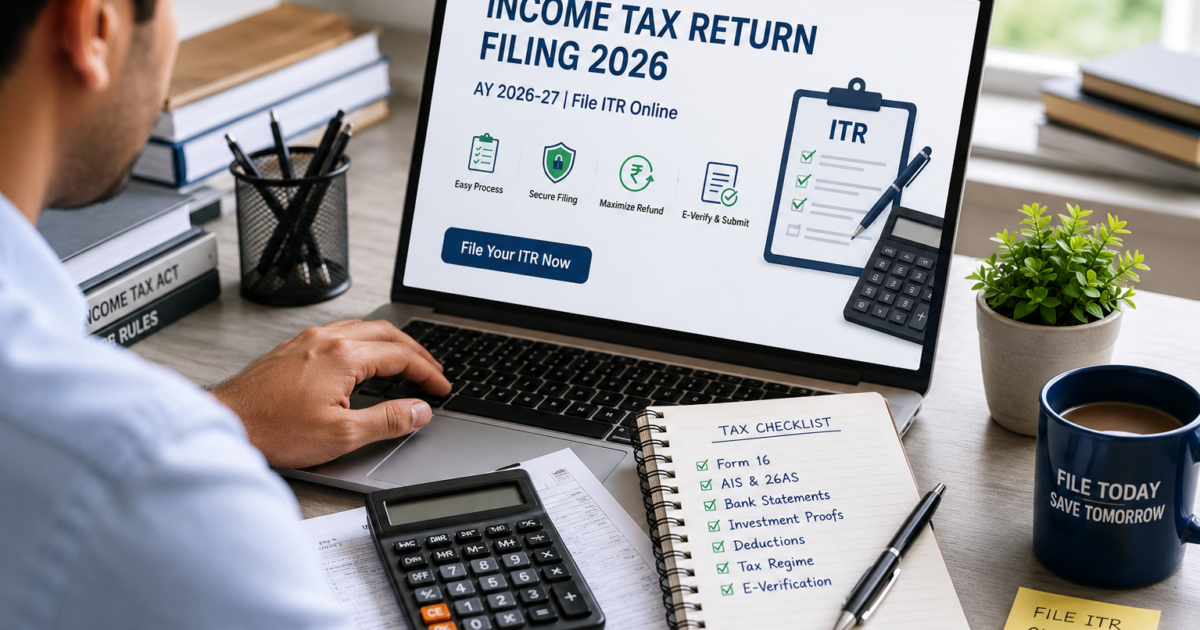
Income Tax Return Filing 2026: Complete Guide for Individuals, Freelancers & Business Owners
Filing your Income Tax Return (ITR) is not simply about calculating how much tax you have to pay. A correctly filed return creates an official record of your income, taxes paid and financial information for a particular financial year.
For salaried employees, freelancers, professionals, investors and business owners, timely Income Tax Return filing can also make several financial processes easier. An ITR acknowledgement may be useful when applying for a loan, processing certain visa applications, demonstrating income or carrying forward eligible losses.
For Assessment Year (AY) 2026-27, taxpayers are filing returns for income earned during Financial Year (FY) 2025-26. The Income Tax Department has made ITR-1, ITR-2, ITR-3 and ITR-4 available for AY 2026-27.
If you are wondering how to file ITR online, which form to choose, which documents you need or what happens if you miss the deadline, this guide covers the important points.
What Is Income Tax Return Filing?
An Income Tax Return is a statement submitted to the Income Tax Department containing details of your income, applicable deductions, taxes paid and tax liability.
Depending on your income sources, you may have salary income, rental income, interest income, dividend income, capital gains, business income or professional income.
The important part is not just filing a return, but filing the correct ITR form with accurate information.
This is especially important if you have multiple sources of income such as salary plus stocks, mutual funds, rental income, freelancing or foreign income.
Income Tax Return Filing Due Date 2026
There is no single ITR filing deadline for every taxpayer. The applicable date depends on your income source and whether your accounts are subject to tax audit.
For AY 2026-27, the commonly applicable deadlines are:
| Taxpayer Category | Common ITR Forms | Due Date |
|---|---|---|
| Salaried individuals, pensioners and other non-business taxpayers | ITR-1 / ITR-2 | 31 July 2026 |
| Business owners & professionals not requiring audit | ITR-3 / ITR-4 | 31 August 2026 |
| Taxpayers requiring tax audit | Applicable audit ITRs | 31 October 2026 |
| Transfer pricing cases | Applicable forms | 30 November 2026 |
| Belated return | Applicable ITR | 31 December 2026 |
| Revised return | Applicable ITR | 31 March 2027 |
The due date for a particular taxpayer should always be checked against the latest Income Tax Department notification applicable to that taxpayer.
Which ITR Form Should You Select?
One of the most common mistakes taxpayers make is selecting an ITR form without first checking their income sources.
Here is a simplified overview.
ITR-1
ITR-1 is generally applicable to a resident individual, other than a Not Ordinarily Resident, having total income up to ₹50 lakh from eligible sources such as salary/pension, one house property and other sources.
For AY 2026-27, ITR-1 can also cover certain long-term capital gains under Section 112A up to ₹1.25 lakh, subject to the applicable conditions.
However, ITR-1 cannot be used in several situations, including certain cases involving foreign assets/income, short-term capital gains, unlisted shares, income above the specified limit and other specified circumstances.
Best suited for: Eligible salaried individuals and pensioners with relatively straightforward income.
ITR-2
ITR-2 is generally used by individuals and HUFs who are not eligible for ITR-1 and do not have income from business or profession.
For example, taxpayers with certain capital gains, multiple income sources or foreign income may need to consider ITR-2 depending on their circumstances.
Best suited for: Individuals with eligible capital gains, multiple house properties or other income situations where ITR-1 is not applicable.
ITR-3
ITR-3 is applicable to individuals and HUFs having income from business or profession, along with other eligible sources of income.
This form may be relevant for professionals, freelancers, traders and business owners whose income cannot be appropriately reported through ITR-4.
Best suited for: Business owners, professionals and individuals with business/professional income requiring ITR-3.
ITR-4
ITR-4 is designed for eligible resident individuals, HUFs and firms other than LLPs having income from eligible business or professional activities computed under the presumptive taxation provisions, subject to the applicable conditions.
It can be relevant for eligible taxpayers using presumptive taxation under provisions such as Sections 44AD, 44ADA or 44AE.
Best suited for: Eligible small businesses and professionals opting for presumptive taxation.
How to File ITR Online in India
The online ITR filing process can be completed through the Income Tax Department’s e-Filing portal. However, taxpayers should first collect and verify their financial information.
Step 1: Keep Your PAN and Aadhaar Details Ready
Your PAN is a key identifier for income tax compliance. Make sure your personal information is correct and your relevant identity details are updated.
Step 2: Collect Your Income Documents
Depending on your income profile, you may need documents such as:
- Form 16
- Salary slips
- Bank statements
- Interest certificates
- Capital gains statements
- Dividend information
- Rent/property-related information
- Home loan information
- Investment and deduction proofs
- Details of business or professional income
- Foreign income or asset information, where applicable
Not every document needs to be uploaded with the ITR. However, maintaining proper supporting records is important.
Step 3: Check AIS and Form 26AS
Before submitting your return, compare your reported income and taxes with the information available in your Annual Information Statement (AIS) and Form 26AS.
This can help identify discrepancies in TDS, interest income, securities transactions and other reported information before you submit your ITR.
Step 4: Select the Correct ITR Form
Do not select ITR-1 simply because you are salaried.
For example, a salaried employee who also has certain capital gains may need ITR-2 instead. Similarly, a freelancer or professional may need ITR-3 or ITR-4 depending on the nature of the income and eligibility.
Step 5: Compare the New and Old Tax Regimes
The applicable tax regime can significantly affect your final tax liability.
Before filing, compare your tax calculation under the New Tax Regime vs Old Tax Regime, considering your eligible deductions, exemptions and income structure.
For taxpayers with investments, housing loans, HRA and other eligible deductions, the comparison may require more than simply looking at the tax slabs.
Step 6: Review Your Tax Calculation
Check:
- Total income
- TDS
- Advance tax
- Self-assessment tax
- Deductions
- Tax payable
- Refund amount
- Bank account details
Never assume that pre-filled information is automatically correct. Review it before submission.
Step 7: Submit and E-Verify Your Return
After filing, the return must be verified using an available verification method.
A return that is submitted but not properly verified can create unnecessary complications. Therefore, complete the verification process after filing.
Documents Required for ITR Filing
The exact documents required depend on your income profile.
For Salaried Employees
Commonly required information includes:
- Form 16
- Salary details
- Bank interest information
- AIS
- Form 26AS
- Investment/deduction information
- Home loan details, if applicable
- Rent/HRA information, where applicable
For Freelancers and Professionals
Freelancers may additionally need:
- Professional receipts
- Bank statements
- Business expense information
- TDS certificates
- Client payment records
- Details required for presumptive taxation, where applicable
For Investors
If you have investments, keep relevant statements for:
- Shares
- Mutual funds
- Securities
- Property transactions
- Dividends
- Other capital assets
Accurate capital gains reporting is particularly important because transaction data may be available through multiple reporting channels.
New Tax Regime vs Old Tax Regime: Which One Is Better?
There is no universal answer to which tax regime is better.
The right choice depends on your income, deductions, exemptions and financial situation.
The Old Tax Regime may be worth comparing when you have significant eligible deductions or exemptions.
The New Tax Regime may be more attractive for taxpayers who have fewer deductions and prefer a simpler tax structure.
Instead of choosing a regime based only on what your colleagues or friends are using, calculate your tax liability under both applicable options.
For salaried employees, factors such as HRA, eligible investments, home-loan interest and other deductions can affect the comparison.
Tip: The lowest tax liability is not always obvious from your salary alone. Compare both regimes using your complete financial information before filing.
ITR Filing for Salaried Employees
For most salaried taxpayers, the filing process begins with Form 16. But Form 16 alone may not show the complete picture.
You may also have:
- Savings account interest
- Fixed deposit interest
- Dividends
- Capital gains
- Rental income
- Other taxable income
Therefore, ITR-1 filing for salaried individuals should ideally involve reconciliation of Form 16, AIS and Form 26AS.
A mismatch between your return and reported information can lead to questions or require clarification later.
ITR Filing for Freelancers and IT Professionals
Freelancers, consultants and IT professionals often have a different tax profile from salaried employees.
Income may come from multiple clients, online platforms or even foreign clients. Business-related expenses and presumptive taxation can also become relevant.
Eligible professionals may consider the provisions of Section 44ADA, subject to the conditions and limits applicable to them.
The correct ITR form depends on the taxpayer’s circumstances. A freelancer should not automatically select ITR-4 simply because they are a professional.
If your income structure includes multiple clients, foreign receipts, significant expenses, investments or other complex transactions, professional tax guidance can help avoid incorrect reporting.
ITR Filing for Small Business Owners and Traders
Small business owners may have to report business turnover, expenses, profit and other financial information while filing their ITR.
Traders and investors can have additional complexity because different types of transactions can have different tax treatment.
For example, taxpayers dealing with securities, F&O transactions or other investment activities should maintain proper transaction records and determine the applicable income classification before filing.
For eligible businesses, presumptive taxation under Section 44AD may simplify compliance, subject to applicable conditions.
Where the business involves complex transactions or audit requirements, professional assistance can be particularly useful.
What Happens If You Miss the ITR Filing Due Date?
Missing the original deadline does not necessarily mean that you cannot file a return.
An eligible taxpayer can generally file a belated return within the permitted period.
For AY 2026-27, the Income Tax Department’s guidance states that a belated return may be furnished by 31 December 2026, or before completion of assessment, whichever is earlier.
However, late filing can have financial and compliance consequences.
Belated ITR Penalty
Under Section 234F of the Income Tax Act, 1961, the late filing fee is:
- ₹1,000 where total income does not exceed ₹5 lakh
- ₹5,000 in other cases
Interest may also apply where tax remains payable.
Another important concern is the potential impact on carrying forward certain losses when the return is filed late.
Therefore, it is usually better to file your return within the applicable deadline instead of waiting until the last date.
How to Claim an Income Tax Refund Online
If the total tax deducted or paid by you is higher than your final tax liability, you may become eligible for a refund.
For example, a salaried employee may have excess TDS deducted during the year.
During ITR filing, reconcile:
- TDS shown in Form 16
- TDS shown in Form 26AS
- TDS and other information in AIS
- Actual income
- Eligible deductions
- Final tax liability
If excess tax has been paid, the refund can be claimed through the ITR.
Always make sure that the bank account selected for refund is correct and eligible for the applicable refund process.
Why You Should Not Wait Until the Last Day to File ITR
Last-minute filing can increase the chances of:
- Choosing the wrong ITR form
- Missing interest or other income
- Incorrect capital gains reporting
- Missing eligible deductions
- AIS/26AS reconciliation errors
- Incorrect bank details
- E-verification delays
- Technical issues on the filing portal
Starting early gives you time to identify discrepancies and get professional assistance if required.
When Should You Consider Professional ITR Filing Assistance?
DIY filing may be convenient when your financial situation is straightforward.
However, professional assistance can be useful when you have:
- Multiple income sources
- Capital gains from shares or mutual funds
- Property sale transactions
- Freelance or professional income
- F&O trading
- Foreign income/assets
- Large deductions
- Business income
- Tax notices
- Previous-year losses
- Complex tax-regime decisions
A tax professional can help review your information, identify the appropriate ITR form and reduce the chances of avoidable filing errors.
Why Choose eFileGuru for Income Tax Return Filing?
eFileGuru & Co. provides CA-assisted tax filing and related tax services for different taxpayer profiles.
Its services include CA-assisted filing for salaried individuals, taxpayers with higher income, capital gains, business/freelancer income, tax audits and property capital gains.
For taxpayers who are unsure about the correct ITR form, tax regime or treatment of different income sources, expert assistance can make the filing process more structured.
eFileGuru also provides a step-by-step filing process where users purchase the relevant service, are assigned an expert, provide their tax information, review eligible exemptions and proceed with ITR filing.
Final Checklist Before You Submit Your ITR
Before clicking the final submit button, review:
- PAN and personal details
- Bank account information
- Form 16
- AIS
- Form 26AS
- Salary and other income
- Interest and dividend income
- Capital gains
- Deductions
- Tax regime
- TDS and advance tax
- Tax payable/refund
- Correct ITR form
- E-verification
A few minutes spent reviewing these details can prevent avoidable mistakes later.
Need Help With Income Tax Return Filing?
Income tax filing becomes more complicated when salary is combined with investments, property, freelancing, business income or capital gains.
If you are looking for CA-assisted ITR filing, tax planning or help with capital gains, business/freelancer income or property-related tax matters, eFileGuru can help you choose the appropriate service and complete the filing process with professional assistance.
Don’t wait until the last day. Prepare your documents, verify your income information and file your ITR within the applicable deadline.
Ready to file your ITR? Connect with eFileGuru and get expert assistance for your income tax return.
Is ITR filing mandatory for everyone?
Not every person is required to file an ITR in every situation. The obligation depends on applicable income-tax provisions and specific conditions. Certain transactions and circumstances can also trigger a filing requirement even where income is below a particular threshold.
How can I file ITR online?
You can file your return electronically through the Income Tax Department’s e-Filing portal. You need to select the applicable assessment year, choose the correct ITR form, provide your income and deduction details, review the return and complete verification.
Which ITR form is best for a salaried person?
An eligible salaried resident individual with qualifying income up to ₹50 lakh may generally use ITR-1. However, factors such as capital gains, foreign income/assets and other circumstances can make ITR-2 or another form applicable.
What documents are required for ITR filing?
Common documents and information include Form 16, AIS, Form 26AS, bank/interest details, investment information and capital gains statements where applicable. Business owners and professionals may need additional financial records.
Can I file ITR after the due date?
Yes, where permitted, a belated return can be filed after the original due date. For AY 2026-27, the general belated-return deadline is 31 December 2026, subject to applicable rules. Late filing fees and other consequences may apply.
Can I claim an income tax refund through ITR?
Yes. If the tax already paid or deducted is higher than your final tax liability, you may be eligible to claim a refund through your ITR.
Should I choose the New or Old Tax Regime?
It depends on your income and eligible deductions/exemptions. The best approach is to calculate your tax liability under both applicable regimes and then choose the option that is beneficial for your circumstances.
Comments
Be the first to share your thoughts.